Starlink Installation for Rural Homes and Small Businesses: What to Expect From a Professional Setup
Updated: Oct 28

If you are considering Starlink installation for rural homes, the quality of the setup matters as much as the equipment itself. Rural properties often bring extra challenges, including trees, awkward rooflines, thick walls, long cable runs and separate buildings. A professional installation is designed to deal with those details properly, so the system is set up to suit how you actually use the property.
For many customers, the goal is not simply to get Starlink working. It is to have a tidy, practical and dependable setup that supports everyday life, whether that means home working, streaming, keeping in touch with family, or running a small business from a rural site.
At Sat-Comms Ltd, we install Starlink and other satellite systems for domestic customers and small commercial clients. From our base in Ammanford, we provide on-site surveys, installation, Wi-Fi setup and cabling for rural properties across Wales and South Wales. Alongside our Starlink installation services, we also help customers improve indoor coverage and connect separate buildings where required.
Why Starlink installation for rural homes needs planning
Starlink is often a strong option for rural properties where fixed-line broadband is limited, but the result still depends on how the system is installed.
The dish needs a clear view of the sky. In practice, that can be affected by nearby trees, outbuildings, roof height and the safest available mounting position. Inside the property, the layout matters too. A large farmhouse, stone walls or a home office at the far end of the building can all affect how well the connection reaches the places that matter most.
Obstructions: Trees and nearby structures can influence where the dish should go.
Mounting options: The best location is not always the easiest one to reach without planning.
Cable routing: Longer or awkward runs need thought to keep the finish neat and practical.
Indoor coverage: Getting broadband onto the property is only part of the job if Wi-Fi struggles indoors.
Outbuildings: Workshops, annexes and offices may need the connection extending beyond the main house.
That is why many people compare DIY against professional installation. The difference is not just convenience. It is about reducing avoidable issues and planning the setup around the building, not forcing the building to work around the kit.
What to expect from a professional Starlink setup
A professional installation should start with the property, not just the box of equipment. When we install a system, we look at the whole route from the dish to the way the connection will be used indoors.
Site survey and initial assessment
We assess the property, likely mounting locations, possible obstructions, cable routes and router position. This is especially important on rural sites where the easiest visible mounting point may not be the most effective one.
Choosing the right mounting position
The aim is to give the dish the clearest practical view while keeping the installation tidy and suitable for the building. That may mean considering wall mounting, a higher fixing point or another position that balances access, exposure and cable routing.
Safe, tidy cable routing
A good install should not leave you with awkward trailing cables or equipment placed wherever it happened to reach. Proper routing helps keep the finish neat and makes the setup more practical inside the home or business.
Router placement and indoor Wi-Fi planning
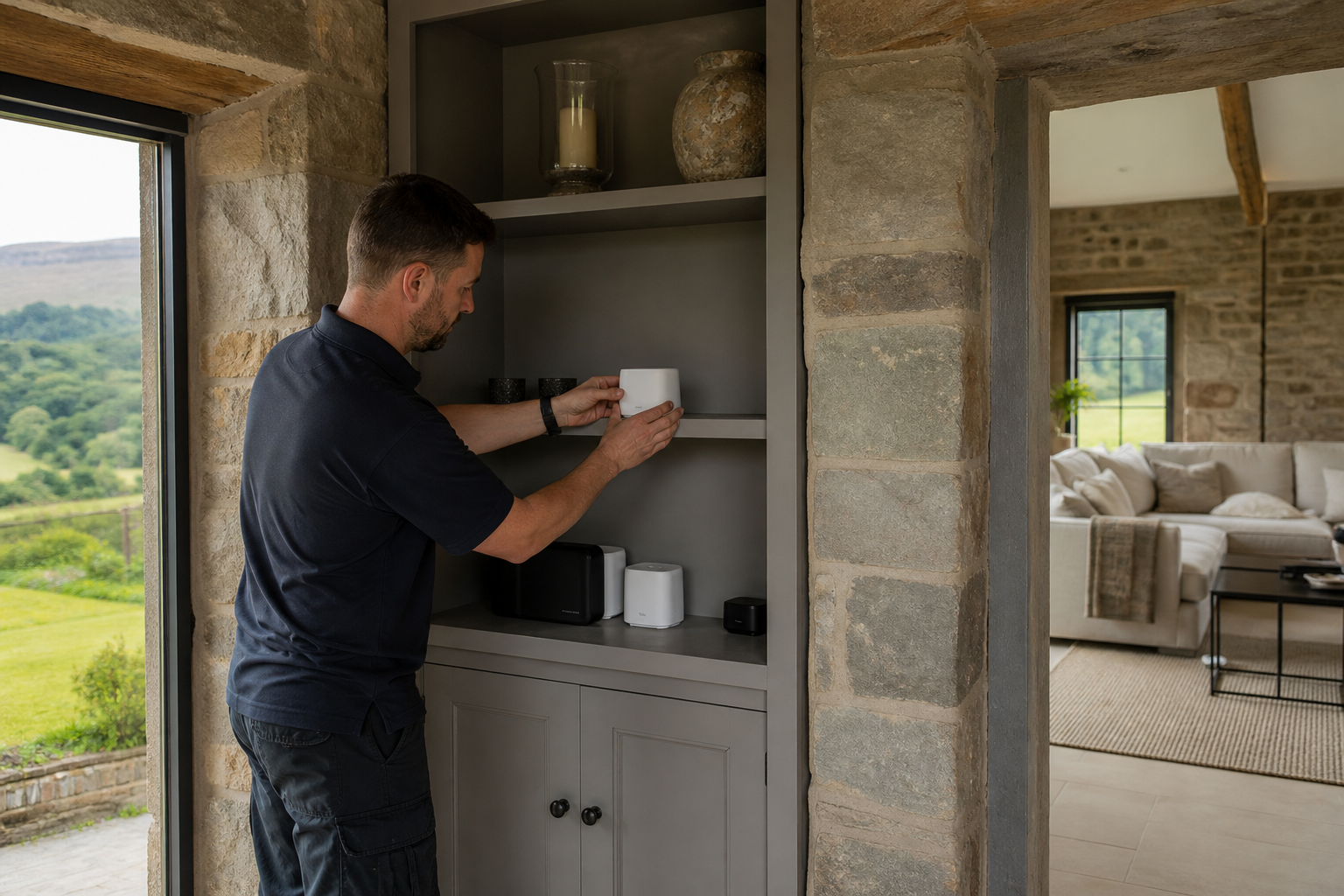
The Starlink connection only becomes useful once it reaches the rooms where people actually work and live. If the property is larger, has thick walls or includes separate work areas, the router position and wider Wi-Fi setup matter. We can also help with WiFi and wireless networks where extra coverage is needed.
Testing and handover
Once installed, the system should be checked in real use, not just powered on and left. That includes confirming the equipment is operating correctly and making sure the customer understands the setup.
For some properties, the broadband source is only one part of the project. If you need internet in a home office, workshop, barn or other outbuilding, we can also combine the installation with computer networking and cabling or wireless links between buildings.
DIY or professional installation: which is right for you?
When DIY may be straightforward
If the mounting point is simple to access, the cable route is short and the indoor layout is easy, some customers are comfortable with a self-install. That can work well on a straightforward property with a clear sky view and no additional networking requirements.
When professional installation makes more sense
A professional setup is often worth it when the property is more complex or when you want a cleaner result from the outset. That is especially true if:
The best dish location is not obvious.
The building has stone walls, awkward access or a longer cable run.
You need Wi-Fi to work beyond the room where the router sits.
You want the connection extended to an annexe, office or other outbuilding.
You are installing for a small business and need the setup planned properly for day-to-day use.
In other words, the more rural and awkward the site, the more value there usually is in getting the installation planned around the property.
Common setup considerations for rural homes and small businesses
Dish position matters more than most people expect
The most visible part of the installation is the dish, but choosing where it goes is not just about where there is empty wall space. The position should suit the sky view, the structure of the building and the route back indoors.
Indoor Wi-Fi can still be the weak point
It is common for customers to focus on the broadband source and then discover the real issue is inside the property. Large homes, older buildings and thick internal walls can all affect coverage. That is why a Starlink installation often works best when it is planned alongside the wider home network rather than treated as a stand-alone product.
Separate buildings may need an extra network solution
If your office, workshop or annexe sits away from the main house, the Starlink router alone may not be enough. In those cases, we can look at how the connection should be extended across the site so it remains usable where you need it most.
Small businesses need practicality, not guesswork
For a rural small business, internet is often part of everyday operations. That could include email, cloud access, customer communication, card payments or video calls. A professional installation helps make sure the system is planned with those practical needs in mind rather than treated as a quick add-on.
How we approach Starlink installations at Sat-Comms Ltd
We are not generalists guessing our way through rural connectivity. Sat-Comms Ltd has over 20 years' experience in satellite and rural broadband installation work. We install Starlink and other satellite systems, fit mesh Wi-Fi, and create links between buildings for both domestic customers and small commercial clients.
From our base in Ammanford, we work on rural properties across Wales and South Wales. We provide installation site surveys, can supply installation kits where required, and can also fit equipment provided by the customer. Where applicable, we can also work on jobs funded through rural grant schemes.
That combination matters because many rural customers do not just need one item fitted. They need the broadband source, the indoor Wi-Fi and the building-to-building connectivity to work together as one practical system.
Frequently asked questions
Is Starlink a good option for homes with limited rural broadband?
It can be a practical option where fixed-line choices are limited, but the right answer depends on the property, any obstructions and how the connection needs to be distributed indoors. A site survey helps identify the most suitable setup.
Can Sat-Comms Ltd install Starlink kit that I have already bought?
Yes. We can supply installation kits where required, or fit equipment provided by the customer.
Will I need mesh Wi-Fi with a Starlink installation?
Not always. In a smaller and simpler property, the standard setup may be enough. Larger homes, thick walls and separate work areas are more likely to benefit from added Wi-Fi planning or a mesh setup.
Do you install Starlink for small businesses as well as homes?
Yes. We work for domestic customers and small commercial clients, including rural premises that need a practical on-site installation.
Can Starlink be used for an annexe, workshop or office in another building?
Yes, but it may need more than the standard router placement. Depending on the distance and layout, the best answer may involve cabling, mesh Wi-Fi or a wireless link between buildings.
Book a site survey with Sat-Comms Ltd
A well-planned Starlink installation can make a real difference on a rural property, but the best result comes from matching the setup to the site. If you want a professional installation that takes mounting, cabling, Wi-Fi coverage and day-to-day use into account, book a site survey with Sat-Comms Ltd.
We install Starlink systems for rural homes and small commercial clients, and we can also help with wider rural broadband, Wi-Fi and network connectivity across the property. To discuss your setup, call us on 01269 240000 or 07833 432476, or email info@Sat-Comms.co.uk.
If you are ready to improve connectivity at your property, we will help you plan a Starlink installation that is practical, tidy and designed around the way you use your home or business.